
What You’ll Learn: This guide breaks down the two main ways your California home insurance pays out after a disaster: replacement cost and actual cash value. You’ll understand the big differences, why one is usually better, how they affect your premium, and what to look for in your own policy. We’ll talk about real California challenges, like wildfires and rising construction costs, and help you figure out what makes sense for your home.
Understanding Your Home Insurance in California: Replacement Cost vs. Actual Cash Value
For most California homeowners, insurance isn’t just a bill you pay. It’s a promise. A promise that if something terrible happens – a fire rips through your Ventura County home, or a mudslide damages your property in the Santa Monica Mountains – you can rebuild. But how that promise gets fulfilled depends on a couple of key terms: replacement cost and actual cash value.
Honestly, these terms sound like insurance jargon. They are. But understanding them makes a huge difference in how much money you actually get if disaster strikes. It could mean the difference between getting enough to rebuild your life or coming up significantly short. That’s not a small thing, especially with California’s sky-high construction costs.
Step 1: The Gold Standard – Replacement Cost Coverage
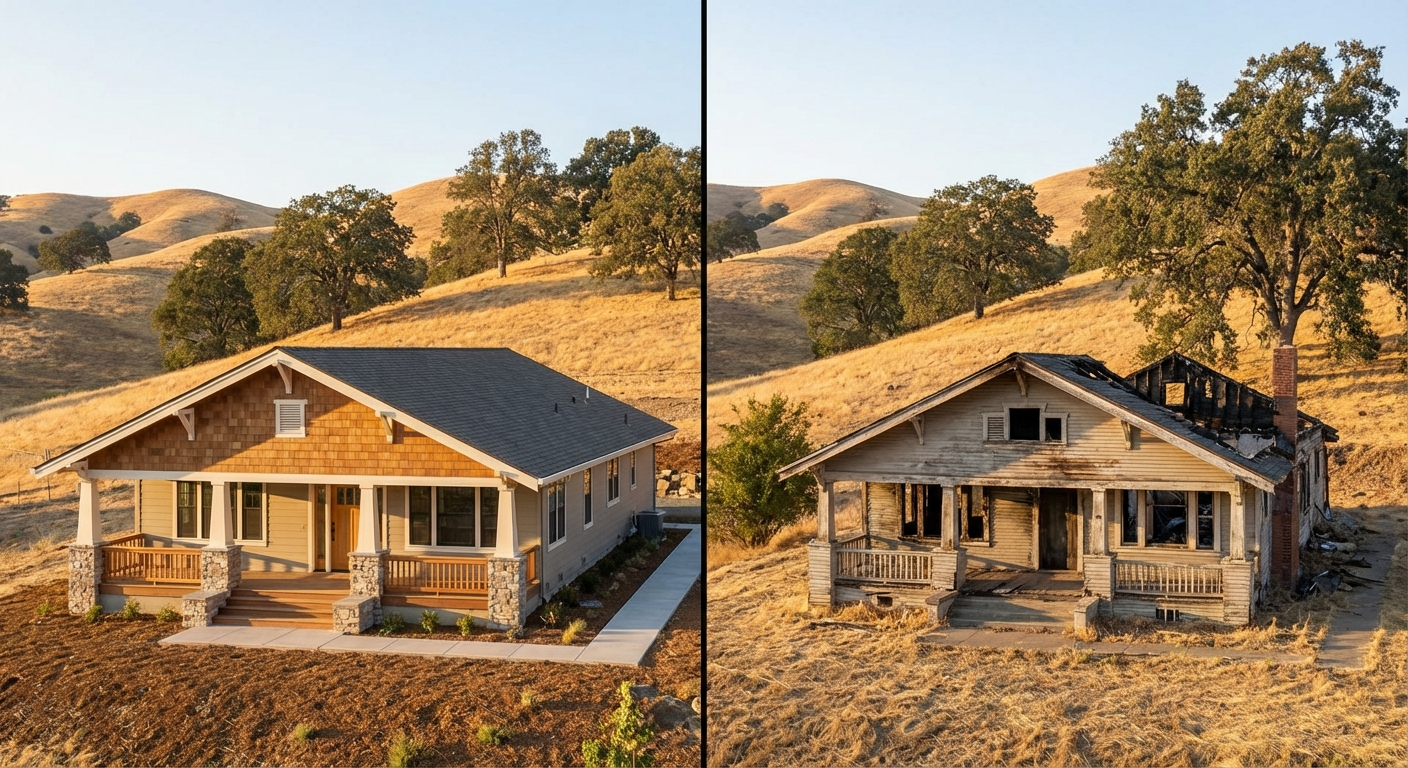
Let’s start with replacement cost. This is the one most homeowners want, and for good reason. Simply put, replacement cost coverage pays to rebuild your home or replace your damaged belongings with new ones, at today’s prices, without subtracting for depreciation. Imagine your roof gets torched in a wildfire. A replacement cost policy will pay for a brand-new roof, using current materials and labor rates, even if your old roof was 15 years old.
Think about that for a second. If your home in the Inland Empire burns down, the cost to rebuild it today is probably much higher than what it cost to build 20 years ago. Materials cost more. Labor costs more. Permitting fees? They’ve definitely gone up. Replacement cost coverage aims to make you “whole” again. It helps you get back to where you were before the loss, without having to dig into your own savings to cover the gap.
This type of coverage is especially important in California. Why? Because rebuilding here is expensive. A fire in the Valley, for instance, can leave thousands needing contractors all at once. That demand drives up prices. Materials like lumber or concrete? Their costs have jumped dramatically in recent years. So, having a policy that keeps up with those real-world costs is incredibly important.
Extended Replacement Cost and Guaranteed Replacement Cost
Here’s where it gets interesting. Even within replacement cost, there are a couple of variations you might see:
- Extended Replacement Cost: This offers a little extra cushion. If rebuilding costs for your home in, say, Malibu, suddenly shoot up beyond your policy’s stated dwelling coverage limit – maybe due to a sudden surge in demand after a major regional disaster – an extended replacement cost clause might pay an additional 10%, 20%, or even 25% above your policy limit. It’s like a safety net for unexpected price spikes.
- Guaranteed Replacement Cost: This is the ultimate protection. It means the insurer will pay whatever it costs to rebuild your home, period, even if it goes well over your policy’s dwelling limit. This is rare to find these days, especially in California’s challenging insurance market, but if you can get it, it offers incredible peace of mind. Not many carriers like State Farm or Farmers offer this anymore, but it’s good to know what it is.

Step 2: The Other Side – Actual Cash Value (ACV)
Now, let’s talk about actual cash value, or ACV. This is the less desirable option for most homeowners. An ACV policy pays to replace your damaged property minus depreciation. What’s depreciation? It’s the decrease in value due to age, wear, and tear. Your 15-year-old roof? It’s not worth as much as a brand new roof. Your 10-year-old couch? Same story.
Imagine your home in San Diego suffers water damage, and you need to replace a few kitchen cabinets. If you have an ACV policy, the insurer won’t pay for brand new cabinets. They’ll figure out what your old cabinets were worth right before the damage – factoring in their age and condition – and pay you that amount. You’d be on the hook for the difference to buy new ones.
For personal belongings, ACV can be particularly painful. That television you bought five years ago? It’s worth a lot less now. Your clothes, furniture, appliances – they all lose value over time. An ACV payout means you’d get only a fraction of what it would cost to buy new versions of those items.
Why would anyone choose ACV? Sometimes, it’s the only option available for certain types of coverage or in specific situations. For instance, the California FAIR Plan, which provides basic property insurance for those who can’t get it in the standard market, often offers ACV for certain coverages. It’s also cheaper. But that lower premium comes at a significant cost if you ever need to file a claim.
Step 3: Why This Choice Matters So Much in California
California isn’t just any state. We face unique challenges. Wildfires are a constant threat, especially in areas like the Sierra Nevada foothills or the brush-heavy canyons of Southern California. Earthquakes are a reality. Mudslides, like those we’ve seen in recent years, can devastate homes. When these events happen, the need to rebuild or replace is immediate and often widespread.
Consider the hypothetical 2025 LA fires. If thousands of homes were damaged, the demand for contractors, building materials, and skilled labor would skyrocket. Prices would surge. If your policy only paid out actual cash value, you’d be in a terrible spot. You’d get a check for depreciated items and a depreciated home, but face inflated costs to rebuild. You’d literally be paying out of pocket just to get back to square one.
That’s not the whole story. California’s housing market is notoriously expensive. Construction costs have been steadily climbing. Permitting processes are complex and can add significant time and expense. All these factors mean that getting enough money to rebuild properly is harder here than in many other parts of the country. A replacement cost policy offers a much stronger financial shield against these realities.
Step 4: Looking at Your Policy – What to Ask
So, how do you know what kind of coverage you have? It’s right there in your policy documents. Look for sections detailing “Coverage A – Dwelling” and “Coverage C – Personal Property.” These sections should specify whether the payout is on a “Replacement Cost Value” (RCV) or “Actual Cash Value” (ACV) basis.
But wait — insurance policies can be dense. They’re not exactly a light beach read. If you’re unsure, the best thing to do is pick up the phone and talk to your insurance agent. Ask direct questions:
- “Is my dwelling covered for replacement cost or actual cash value?”
- “Are my personal belongings covered for replacement cost or actual cash value?”
- “Do I have extended or guaranteed replacement cost for my dwelling?”
- “What’s the difference in premium if I switch from ACV to RCV for my personal property?”
An experienced agent, like Karl Susman of Los Angeles Home Protection, CA License #OB75129, can walk you through your current policy and explain exactly what you’re covered for. They can also help you understand your options for increasing your coverage if you find you’re underinsured. Don’t guess. Get clarity.
Ready to review your coverage or explore new options? Get a free quote today!
Step 5: The Cost Factor – Premiums and Trade-offs
Naturally, replacement cost coverage usually costs more than actual cash value coverage. Insurers are taking on more risk by promising to pay for new items regardless of age. They’re essentially protecting you from depreciation, and that protection comes with a price tag.
For most homeowners, that extra cost is absolutely worth it. The peace of mind alone is significant. The financial hit you’d take with an ACV policy after a major loss could be devastating. Paying a bit more upfront to avoid a massive out-of-pocket expense later just makes good financial sense, especially when you consider how quickly rebuilding costs can escalate in California.
Which brings up something most people miss. The California insurance market has been incredibly challenging lately. Some major insurers have pulled back from the state, and rates have jumped significantly – some premiums jumped 40% between 2022 and 2024 for certain areas. This makes finding comprehensive, affordable coverage tougher. Prop 103, passed decades ago, still influences how rates are approved, but it hasn’t stopped the general upward trend.
In this environment, some homeowners might be tempted to choose ACV to save money. But consider the long-term consequences. What good is a cheaper policy if it doesn’t give you enough to rebuild your life after a total loss? It’s a tough balance, but most experts would agree that skimping on dwelling coverage is a false economy.
Step 6: Making the Right Choice for Your Home
The decision between replacement cost and actual cash value isn’t just about price; it’s about your personal risk tolerance and financial situation. If you have significant savings set aside specifically for rebuilding your home or replacing all your belongings, then perhaps an ACV policy might seem less risky. But for most families, that’s simply not the case.
Consider the age of your home and your belongings. If everything in your home is brand new, the difference between ACV and RCV might not be huge right now. But that gap grows every year as things age. If your home is older, and your possessions have seen some wear and tear, then replacement cost coverage becomes even more valuable.
Ultimately, you want to protect your biggest asset – your home. You want to ensure that if a disaster strikes, you have the financial means to recover fully. Don’t compromise on the quality of your coverage for a slightly lower premium, especially in a high-risk state like California.
Want to ensure your home is properly protected? Karl Susman and his team at Los Angeles Home Protection (CA License #OB75129) can help you understand your options and find the right coverage. Get your personalized quote today.
Frequently Asked Questions About CA Home Insurance Coverage
Q1: Does my standard California home insurance policy automatically include replacement cost for my dwelling?
Not always. Most standard HO-3 policies do offer replacement cost for the dwelling (the structure of your home). However, for personal property (your belongings), it might default to actual cash value. You often have to specifically add an endorsement to get replacement cost for your personal items. Always check your policy or ask your agent to be sure.
Q2: Can I have replacement cost for my home but actual cash value for my personal belongings?
Yes, absolutely. This is a common setup. Many policies automatically provide replacement cost for the dwelling, but you might need to purchase an upgrade or endorsement to get replacement cost for your personal property. It’s usually more expensive to cover personal property at replacement cost, so some homeowners choose to save a little money here, knowing they’ll get less for their old items if they make a claim.
Q3: What if the cost to rebuild my home exceeds my policy’s dwelling limit?
This is a big concern in California, especially with rising construction costs. If you only have a standard replacement cost policy without extended or guaranteed replacement cost, you’d be responsible for any costs above your policy limit. This is why it’s so important to regularly review your dwelling coverage limit with your agent and consider adding extended replacement cost if available. Don’t let your coverage fall behind current rebuilding costs.
Q4: Does actual cash value apply to earthquake insurance in California?
Earthquake insurance, often purchased separately from your standard home policy through providers like the California Earthquake Authority (CEA), typically has its own rules. For dwellings, it generally pays for repairs or rebuilding based on replacement cost, up to your coverage limit. However, for personal property, it might be on an actual cash value basis unless you specifically choose and pay for replacement cost coverage for contents. It’s a good idea to check the specifics of any earthquake policy you have or are considering.
This article is for informational purposes only and does not constitute financial advice.